

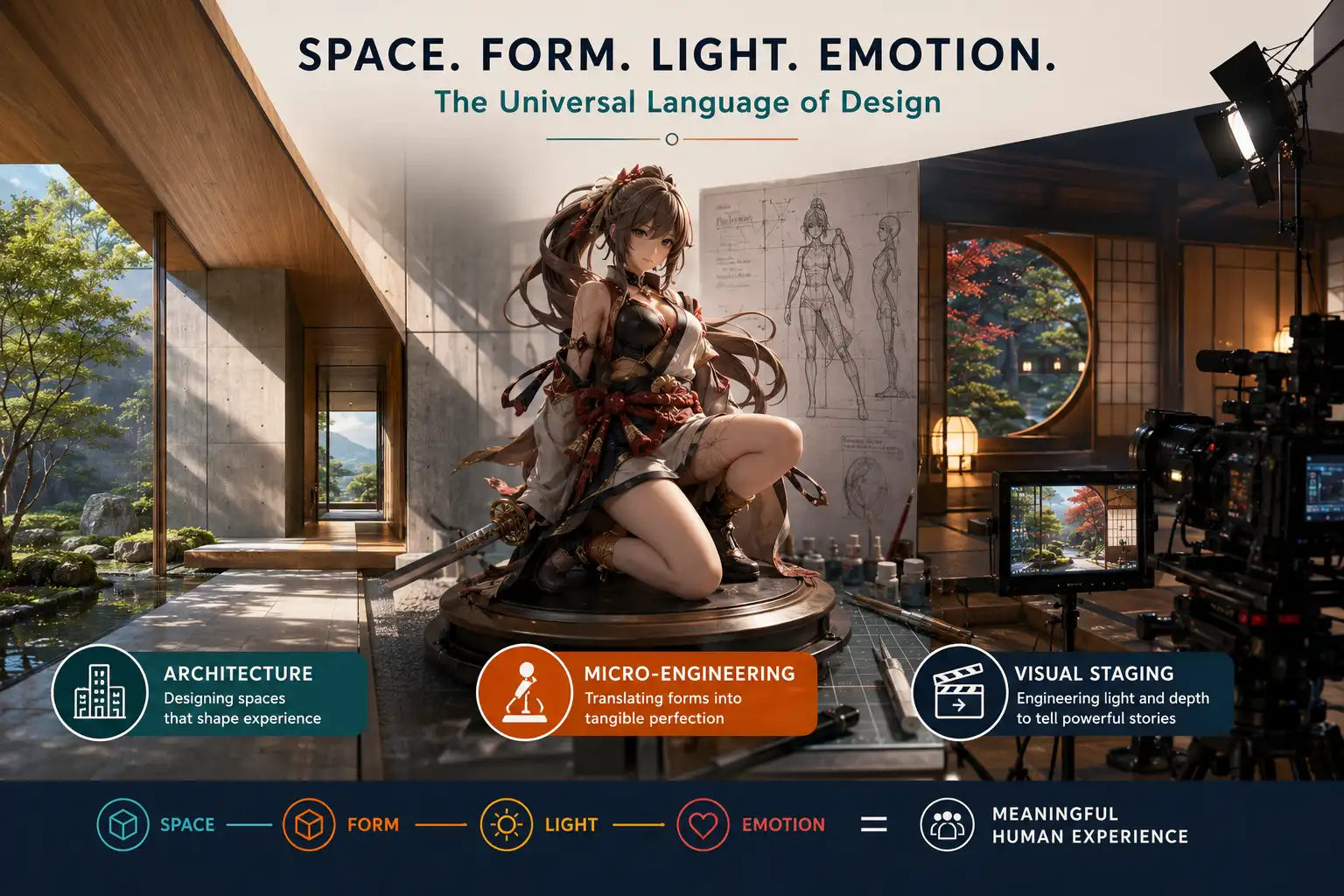
When we examine the evolution of modern design, it is easy to view artistic disciplines through isolated silos. We tend to separate structural engineering, physical figure manufacturing, and visual screen production into completely independent fields. However, when analyzed through the lens of human sensory experience, these distinct creative areas share a singular core philosophy: the intentional manipulation of space, form, and light to evoke human emotion.
In contemporary Japanese design culture, this integrated perspective is especially pronounced. The visual principles that dictate how a building feels to its inhabitants are closely tied to the engineering required for detailed physical sculptures and the visual staging used in digital media. By exploring these shared foundations, we can cultivate a deeper appreciation for how high-level design shapes our perception of the physical and visual world.
1. Spatial Memory and Environmental Emotion
Every physical environment we enter creates an immediate, subconscious reaction. Long before a visitor analyzes the wall decor or floor textures, their mind processes the overall volume of space, ceiling elevation, and the direction of natural daylight.
When an experienced architect begins drafting plans for a physical structure, their objective extends far beyond structural safety and load-bearing math. They are designing a sequential journey of movement and feeling. Key principles that guide this spatial experience include:
- Volumetric Contrast: Juxtaposition of narrow, enclosed entryways with soaring, open central rooms to evoke feelings of transition, liberation, and wonder.
- Directional Sightlines: Aligning interior corridors and windows to frame natural outdoor views, turning surrounding landscapes into dynamic visual art.
- Tactile Materiality: Combining contrasting surfaces—such as raw concrete, warm timber, and smooth glass—to create a rich, multi-sensory environment.
In classical Japanese spatial traditions, this emotional narrative relies heavily on Ma—the intentional integration of negative space. An open room or uncluttered area is not seen as empty space waiting to be filled; instead, the physical silence allows natural sunlight, air currents, and changing shadows to become active design elements. This proves that restraint is often one of the most powerful tools in design.
2. Micro-Engineering: Translating Human Forms into Scaled Collectibles
While physical buildings represent spatial design on a macro scale, high-precision figure modeling and product fabrication represent its micro twin. Over the past several decades, the global appreciation for scaled physical models has elevated miniature sculpting into a discipline requiring serious engineering precision.
Consider, for example, the intricate craftsmanship behind a collectible featured on platforms like dolljapan or crafted within specialized figure studios. Bringing a two-dimensional character illustration into three-dimensional physical reality demands an intimate knowledge of human anatomy, weight balance, and synthetic material behavior.
The Technical Stages of Miniature Fabrication
Stage
Primary Discipline
Technical Objective
Anatomical Sculpting
Digital & Physical Modeling
Establishing realistic skeletal balance and dynamic center of gravity
Mold Engineering
Precision Metal Tooling
Splitting complex character models into seamless components for flawless casting
Polymer Selection
Material Chemistry
Formulating high-grade synthetic resins that capture sub-millimeter details
Surface Staging
Multi-Layer Paint Application
Applying subtle gradient airbrushing to simulate natural skin light absorption
The challenges faced by master sculptors closely mirror those encountered in large-scale construction. A dynamic pose with an off-center balance point must be calculated precisely so the internal structure supports the weight without warping over time. Furthermore, sculptors must calculate how ambient room light interacts with the surface material. By utilizing semi-translucent resins, the material absorbs and diffuses light much like real skin, giving the physical piece a soft, lifelike warmth.
3. Visual Staging: Engineering Depth and Atmosphere on Screen
Translating three-dimensional physical presence onto a flat two-dimensional screen presents its own unique set of artistic hurdles. A camera lens naturally flattens spatial depth, alters perspective, and distorts natural lighting setups. Therefore, filmmakers and production designers must artificially reconstruct space to create a convincing visual atmosphere.
In contemporary Japanese entertainment production, spanning mainstream dramatic television, high-concept cinema, and the specialized commercial av industry, set design and lighting layout are central to holding viewer engagement. Production design teams do not simply place cameras in front of actors; they systematically engineer foreground props, background lighting, and actor positioning to build an immersive visual world.
Core Visual Staging Principles
- Framing Within Frames: Utilizing structural features like open doorways, sliding panels, or furniture edges in the foreground to create a strong sense of visual distance.
- Chiaroscuro Depth: Balancing soft primary key lights against deep, subtle shadows to highlight physical volume and contours, giving video scenes a tactile, three-dimensional presence.
- Color Temperature Separation: Using warm light sources on primary subjects while bathing background elements in cool ambient tones to establish natural depth and focus.
When these staging principles are applied correctly, the display screen ceases to feel like a flat glass plane. Viewers feel as though they are looking through an open window into a real, physical space, demonstrating how light and framing can elevate visual media into an art form.
4. The Digital Convergence: Bridging Virtual and Physical Workflows
As we move deeper into the modern technological era, the traditional boundaries separating physical building design, industrial figure sculpting, and cinematic production are fading rapidly. Creative studios now utilize unified digital toolkits that allow artistic ideas to transition smoothly across physical and virtual realms.
This digital crossover has opened up remarkable possibilities:
- Physically Based Lighting Simulations: Rendering engines now track individual light rays as they bounce off virtual surfaces, allowing designers to test natural lighting conditions before laying a single physical brick.
- High-Resolution Additive Manufacturing: Industrial resin printers allow character sculptors to take complex digital mesh files and convert them into physical prototypes with sub-micron detail within hours.
- Virtual Stage Integration: Production studios can now shoot live camera footage in front of massive LED video walls that update digital backgrounds dynamically in real time to match camera movement.
This evolution does not lessen the importance of traditional human skill. On the contrary, an artist who understands physical materials, real-world spatial balance, and natural lighting will always create superior work compared to an operator relying purely on automated algorithms. The tools change, but the core foundation of balance, proportion, and human-centric design remains timeless.
5. The Enduring Value of True Craftsmanship
Why do human beings care so deeply about the finer details of our physical surroundings, our art objects, and the visual media we choose to watch? The answer lies in our fundamental search for beauty, harmony, and authentic emotional connection.
In a fast-moving modern world filled with temporary content, things created with genuine discipline provide a much-needed sense of permanence and quality. When we step into a thoughtfully designed building or hold a beautifully crafted art object, we naturally connect with key qualities:
- Intentionality: Knowing that every structural line, surface texture, and light angle was chosen for a specific reason.
- Proportion: The natural satisfaction we feel when viewing geometric relationships that mirror natural scales and visual rhythms.
- Tactility: The simple, authentic pleasure of touching high-quality surfaces—whether smooth natural hardwoods or soft, dense synthetic polymers.
Final Thoughts: Recognizing the Universal Language of Design
At first glance, a soaring urban skyscraper, a detailed collectible figure, and a carefully lit scene on a screen might seem like entirely unrelated topics. Yet, when we look beneath the surface, we see that they are all bound by the same timeless principles of visual and spatial organization.
Creators across all fields—from urban planners to digital sculptors and cinematographers—are ultimately working with the same raw elements: space, form, light, and human emotion. By training ourselves to see these common threads, we develop a far richer appreciation for the constructed world around us. We begin to realize that great design is not just about decorative style—it is about turning simple materials and visual moments into meaningful, lasting human experiences.